A Concordia College Conversation with President Irvine
How Concordia College Is Navigating Ai, Affordability,And The Future Of Liberal Arts Colin Irvine knows the higher education landscape isn’t slowing down. “It’s astounding how complicated our sector is,” he said. As president of Concordia College in Moorhead, Irvine spends his days balancing strategy and imagination. Enrollment. Innovation. Industry partnerships. AI. Affordability. Student belonging. Athletics


How Concordia College Is Navigating Ai, Affordability,
And The Future Of Liberal Arts
Colin Irvine knows the higher education landscape isn’t slowing down.
“It’s astounding how complicated our sector is,” he said.
As president of Concordia College in Moorhead, Irvine spends his days balancing strategy and imagination. Enrollment. Innovation. Industry partnerships. AI. Affordability. Student belonging. Athletics. The arts.
“My job,” he said, “is supporting my cabinet team as we carry out our strategic plan. Enrollment, academics, advancement, athletics, mission, finance—it’s all connected.”
And in 2026, that connection matters more than ever.
The Transactional Shift
If there’s one major change Irvine sees in today’s students, it’s that college has become more transactional.
“Students are looking for a this-for-that relationship,” he said. “I will give you my time and my money in exchange for a clear outcome—a job, graduate school, something tangible.”
That’s different from when he went to college in the late ’80s and early ’90s.
“There was more of an exploratory mindset. You went to discover who you were going to become.”
Today, families want certainty. And Irvine doesn’t dismiss that. In fact, Concordia has leaned into it.
The college has expanded career-focused programs, strengthened internships, and worked closely with regional employers to ensure students graduate ready to work.
“You come in certain about things,” he said. “You leave with more questions. But paradoxically, you also leave more confident because you’ve learned how to learn.”
Lowering The AI Temperature
Lowering the Temperature the AI Temperature
No conversation about higher education today avoids artificial intelligence.
At Concordia, it’s not being ignored. It’s being embedded.
Last fall, the college held a campus-wide symposium focused entirely on AI. The goal wasn’t panic. It wasn’t prohibition..
It was integration.
“We’re working toward embedding AI as a learning outcome,” Irvine said. “Not as a separate skill, but as part of how students learn and solve problems.”
Still, he’s candid about the anxiety surrounding it.
Six months ago, many high schools and colleges were locked in what he calls a “gotcha game”— trying to catch students misusing AI tools.
“The fear was, ‘How do we make sure students aren’t cheating?’”
But Irvine wants to move beyond that posture
“There’s real anxiety, especially among writing instructors,” he said. “AI can produce coherent, creative essays. So what’s the role of the teacher?”
As a former English professor himself, he understands the tension.
“But what if AI gives us time back?” he said.
Instead of spending 30 minutes grading a paper alone, what if professors used AI to assist with surface-level analysis, and then used that saved time to sit with students, face-toface, discussing how their thinking is evolving?
“Getting on a treadmill is optional. You don’t have to. But you do it because you know it’s good for you.” In the same way, he said, assignments must evolve. If a student chooses to use AI on an assignment they were asked not to, that’s not just a discipline issue, it’s a design issue.
“What was it about my assignment that didn’t motivate you?” he said a professor might ask. “Was it irrelevant? Did I not give you enough time?
The presence of AI forces better questions. And perhaps better teaching.
“When we solve cancer and climate change with AI,” Irvine said, “then we can talk about dialing it back. Until then, let’s combine human creativity with these tools.”
About Concordia College
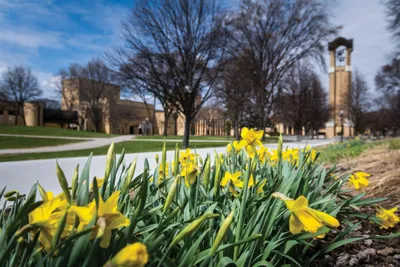
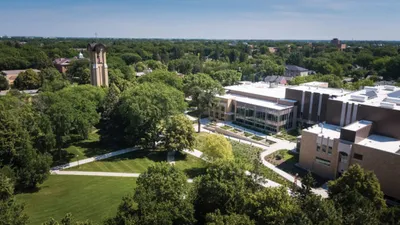
Concordia College in Moorhead, Minnesota, is a private liberal arts college known for its strong sense of community and commitment to academic excellence. Founded in 1891, Concordia offers a wide range of programs in the arts, sciences, and professional fields, encouraging students to think critically and lead with purpose. With a vibrant campus culture and global perspective, Concordia prepares students to make meaningful contributions in their careers and communities.
Real Work, Real Partnerships
Concordia’s evolution isn’t happening in isolation.
Irvine spoke enthusiastically about Fargo-Moorhead’s business community, and how unusually collaborative it is.
“I feel incredibly welcome here,” he said. “The borders between institutions are porous.”
Through organizations like Innovate 28, Concordia leaders sit at the table with business executives, nonprofit directors, and civic leaders. The goal isn’t branding. It’s partnership, and internships are the clearest example.
“How do we create internships that benefit the student — but also serve the company in real, tangible ways?” Irvine asks.
He wants Concordia students solving actual problems for local businesses. Analyzing real data sets. Working on active projects. Learning by doing.
Because if a student contributes meaningfully during their internship, the path to employment becomes clearer, and the region keeps talent.
And for companies Concordia isn’t just a place that sends graduates. It’s a thought partner.
“Bring us your problems,” Irvine said. “Bring us your projects. We’re in the business of solving problems.”
The Affordability Question
For all the innovation, Irvine knows one perception still looms large: Private college equals unaffordable.
“That’s our biggest challenge,” he said. “Helping people understand they can afford this place, and they can succeed here.”
That’s why the Concordia Promise exists.
Now in its third year, the program covers full tuition for students from North Dakota and Minnesota whose families earn under $90,000 annually, after federal and state grants are applied.
“It’s essentially free tuition for those families,” Irvine said.
And beyond that threshold, Concordia continues to layer scholarships to make attendance realistic.
“We are excellent,” he said. “But we are affordable. And we want everyone who wants to be here to be here. Students often think, ‘I couldn’t afford it,’ or ‘I couldn’t succeed there academically.’ And in 99% of cases, they’re wrong. I don’t think most people can even begin to imagine how great life can be until they come to a place like Concordia.”
30 Programs In Two Years
If the stereotype of liberal arts colleges is slow-moving and tradition-bound, Concordia is working hard to rewrite that narrative.
In the last two years alone, the college has launched 30 new academic programs and five new non-academic programs.
The new programs span everything from:
- Cybersecurity Human resources
- Project management
- Financial wealth management
- Exercise science
- Athletic training
- Sports management
- Emerging AI-focused curricula
On the student life side, innovation continues with:
- Women’s flag football
- Clay target shooting
- Expanded esports
- Drumline additions within the Cobber music ecosystem
“Our faculty has done an enormous amount of work,” Irvine said. “We’re offering what students are asking for.”
Program development isn’t guesswork. Concordia works with external data firms to analyze workforce trends, listens closely to prospective students, and stays in constant conversation with regional employers.
What Makes A Cobber
Ask Irvine what has surprised him most during his time at Concordia and his answer is, “The people.”
As a non-alum leading a college deeply rooted in tradition, he wasn’t sure what to expect.
“Every Cobber I meet is brilliant, authentic, and humble,” he said. “They’re genuinely surprised by their success.”
In an era where personal branding dominates, he sees Concordia graduates who quietly do meaningful work, and rarely make a spectacle of it.
“They’re hardworking. They’re kind. They’re capable. And they don’t necessarily realize how exceptional they are.”
The Work Ahead
Higher education is under scrutiny nationally. Demographics are shifting. AI is reshaping industries. Public trust in institutions fluctuates.
Concordia must continue proving its relevance— every year, every class, every graduate.
“We have to help people understand what’s possible here,” he said. “And we have to keep innovating.”
That means expanding programs. Strengthening industry ties. Lowering the temperature around AI. Designing assignments that motivate from within—not just reward with grades
It also means inviting the broader community in.
“Come to campus,” Irvine said. “Come to the concerts. The athletic events. The lectures. Experience the energy.”
Whether you’re a prospective student, a business owner with a dataset that needs analysis, or an alum curious about what’s new—there’s an open door.
“Come understand what it means to be a Cobber,” he said.
concordiacollege.edu
Facebook | /concordiacollege
Instagram | @concordia_mn
Linkedin | /concordia-college
Published March 26, 2026
