A Second Shot At Invention
John McDonough has sold 47 Rocket Ball games, each built by hand in a former dentist’s office in Barnesville. Here’s how he’s turning a kitchen-table invention into a business.


John McDonough had just finished building Rocket Ball No. 58 when he took a picture of its serial number.
At the time of his interview, he had sold 47. Eleven more were ready for whatever came next.
For a man trying to turn an invention into a livelihood between shifts maintaining Fargo’s federal courthouse, those numbers meant something. Every completed game was another small piece of evidence that an idea first assembled on a child’s pool table could become a business.
McDonough had been this far before. Years earlier, an invention of his had reached major retailers without producing the return he had hoped for. This time, he was watching the costs more closely, asking harder questions of suppliers and learning exactly how much work could hide inside something designed for fun.
The game itself moves considerably faster.
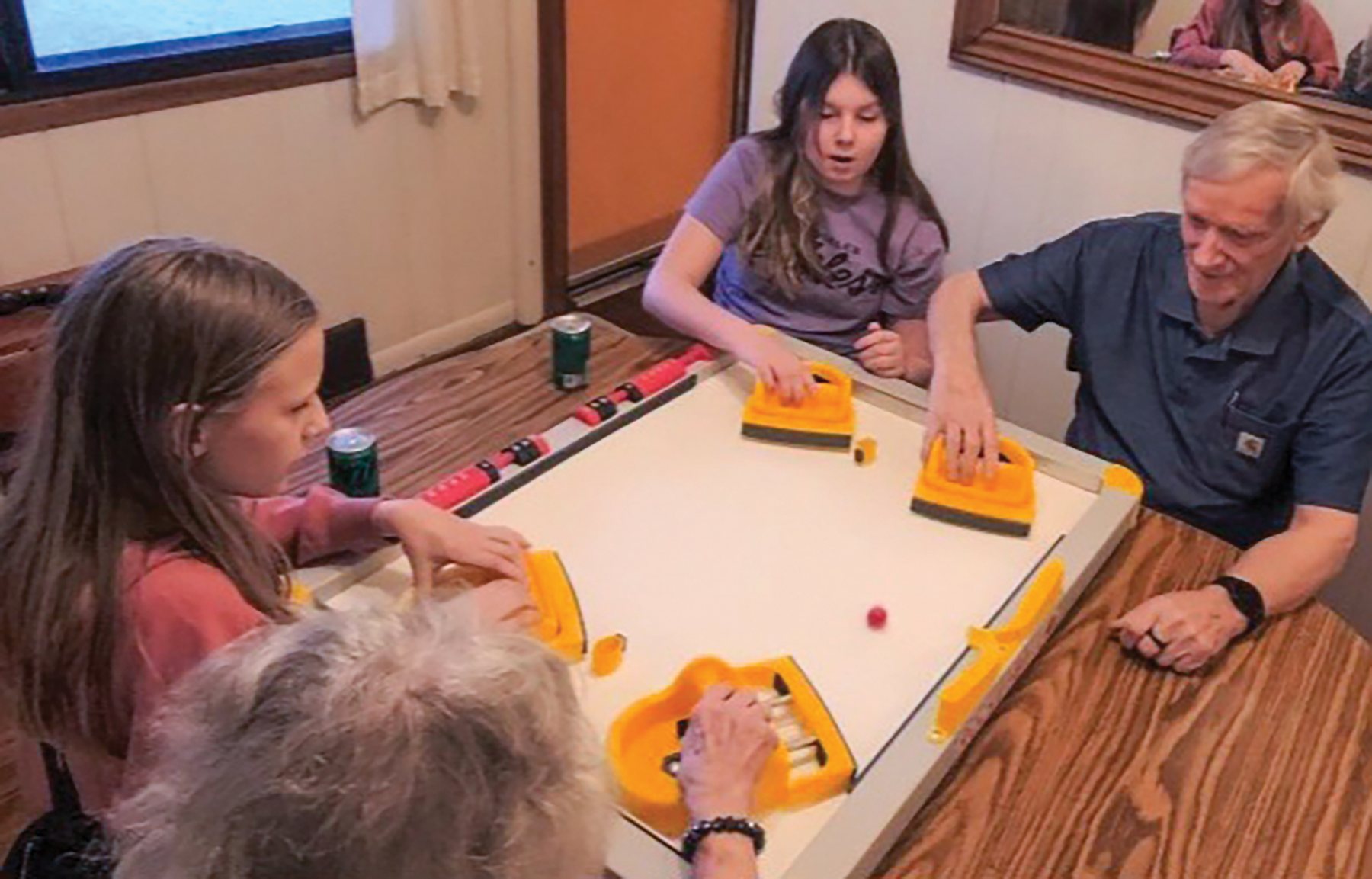
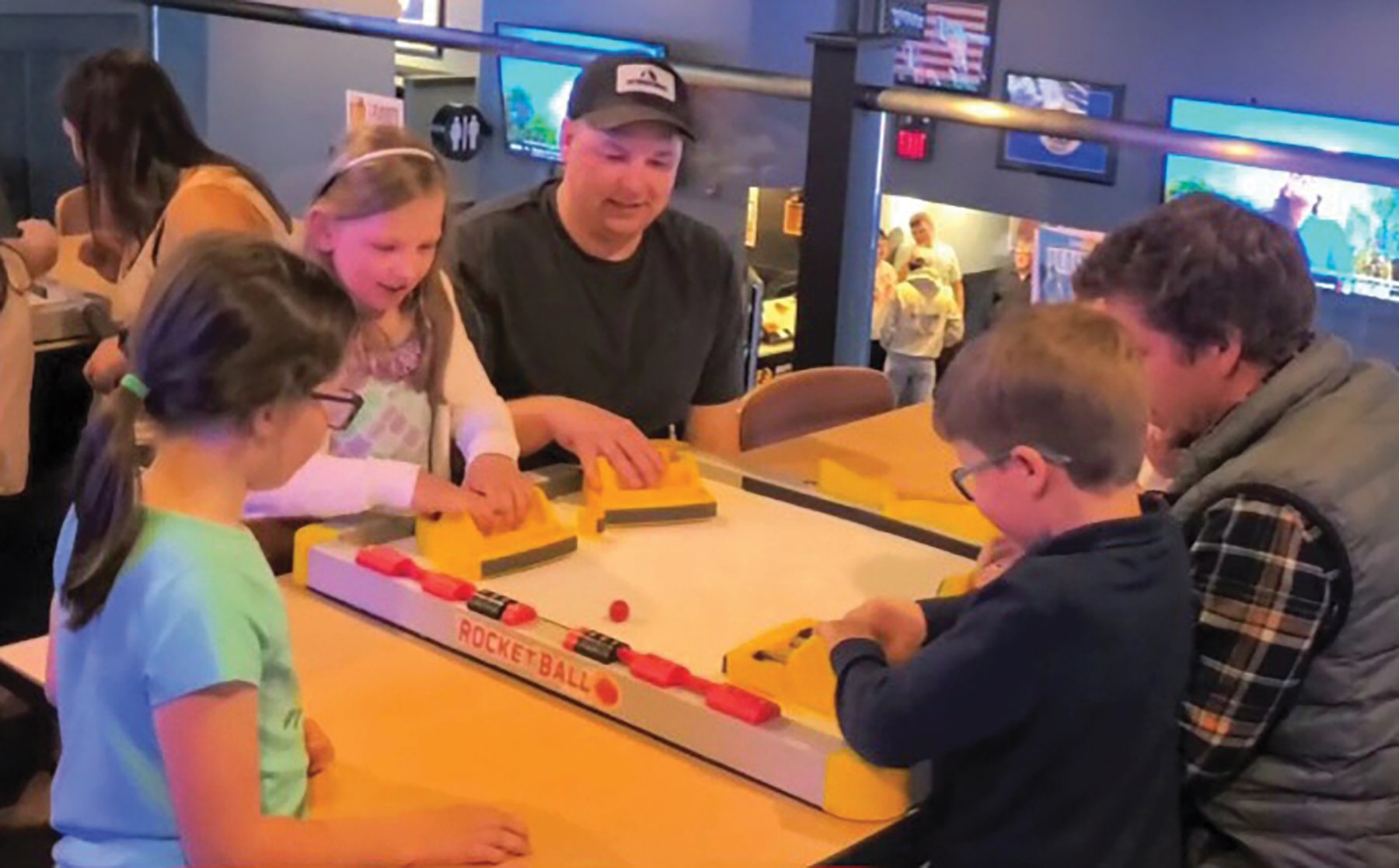
Rocket Ball sends a ball racing between opponents operating hand controls, with a metal bell sounding when someone scores. It can be played head-to-head or with four players, and McDonough describes the action as “real life pong.” There is no screen to watch. The person to beat is sitting across the table.
“You can block any shot if you’re fast enough,” McDonough said.
Getting a business off the ground requires a different kind of timing.
Rocket Ball: An Idea Built to Move
McDonough’s professional background is in heating and air conditioning. He studied the trade in the Moorhead area in the mid-1980s, then spent four years working in Phoenix before returning north in 1990.
The Arizona heat left an impression. “You couldn’t leave your tools out on the roof,” he said. “If you came back 10 minutes later, you wouldn’t be able to touch them.”
By the time of the interview, he had spent about 20 years as a maintenance technician at the federal courthouse in Fargo. His workdays involve the practical problems of keeping a building operating like lighting, plumbing, heating, cooling, and generators.
Rocket Ball began with a problem he chose for himself. Could he create a game for a kitchen table that would make a ball move really fast?
He assembled a hand control from wood and aluminum, using his thumb as the primary trigger. Once that worked, he built three more and mounted all four to a child’s pool table.
Adding an opponent changed the possibilities. Players could send the ball back with enough speed that the next return depended on timing, positioning, and anticipation. With two players on each side, teamwork added another layer.
The basic action was easy to understand. Getting good at it could take longer.
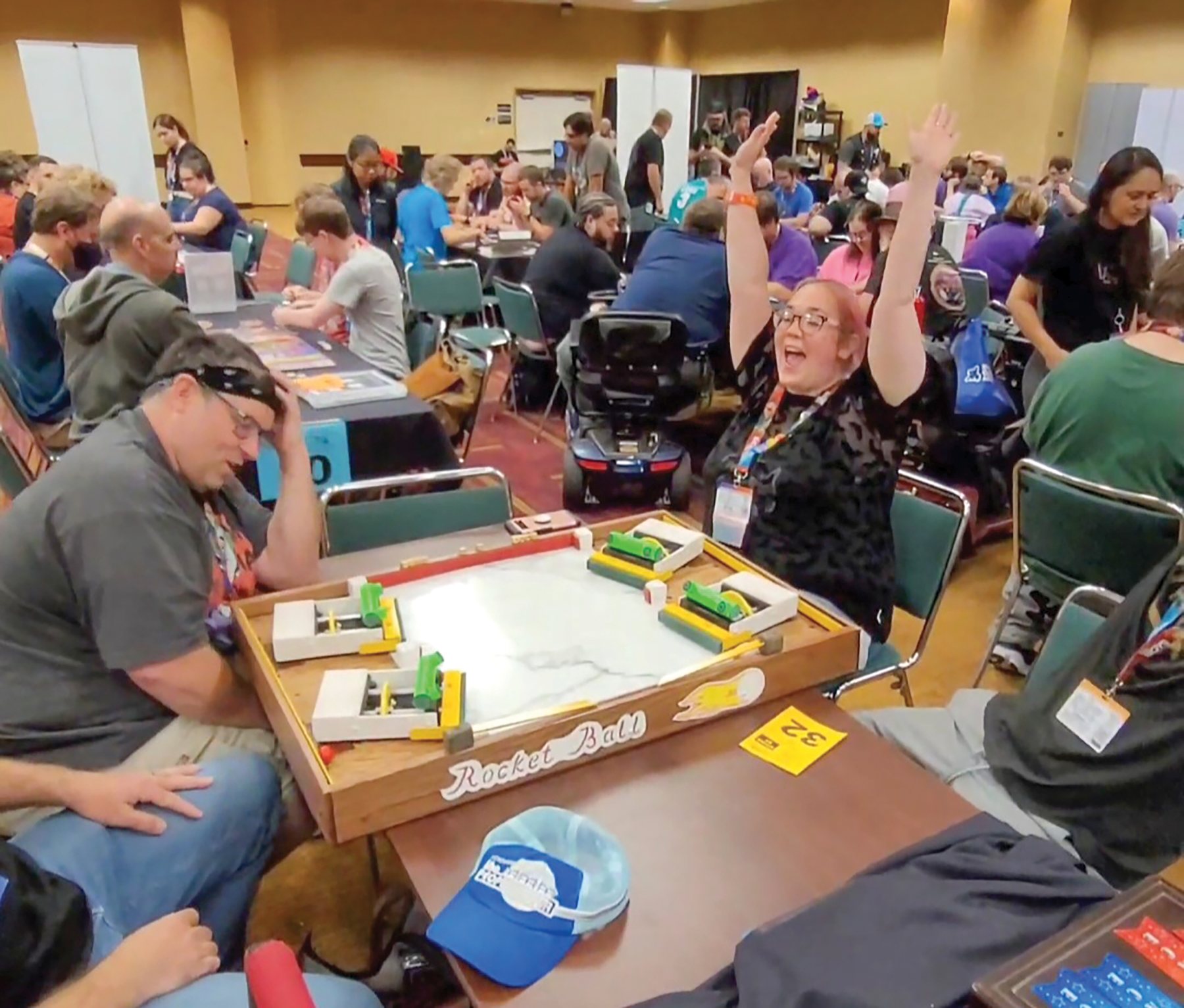
McDonough asked friends to try the prototype and tell him whether it was worth pursuing protection for the invention. Their encouragement helped move him forward. But a larger test came in 2023, when he took a bulky wooden prototype to Gen Con in Indianapolis.
He traveled there alone with a game he estimated weighed about 30 pounds. According to McDonough, roughly 70 people tried it, playing hundreds of games and filling out surveys afterward. He recalled strong interest in owning one at a price of a couple hundred dollars.
Those reactions gave him a reason to keep going. They also gave him a challenge to turn the wooden prototype into something he could manufacture and sell.
After returning home, he brought the project to Applied Engineering. An engineer helped translate his homemade version into a design using plastic and aluminum.
What the Rake Taught Him
Long before Rocket Ball, McDonough tried to improve another familiar activity: raking a lawn.
His early design used three rake heads. In the 1990s, producing it meant cutting up existing rakes and assembling the inventions themselves. A later version, called the Rapid Rake, placed one rake behind another in a spring-loaded design.
It worked quickly, he said, although moving multiple rake heads also demanded more effort from the user.
The product reached Menards and numerous Ace stores, according to McDonough. Distribution, however, did not solve the economics. Sales and profit margins were not strong enough to sustain the venture.
“It just didn’t have the sales to justify,” he said. “We weren’t making enough of a profit margin.”
The experience changed how he approached his next product. He wanted evidence that people enjoyed using Rocket Ball before committing heavily to protecting it. He paid closer attention to budgets. He became more willing to negotiate.
Supplier prices, he learned, deserved questions. Could another company make a part more affordably? Could a design change shorten assembly time? Would a larger order reduce the cost enough to matter?
Those questions follow him through Rocket Ball’s development because he has already experienced the gap between getting a product into stores and making money from it.
Inside the Former Dentist’s Office
Rocket Ball’s assembly operation occupies a former dentist’s office on Front Street in Barnesville, Minnesota.
When McDonough described the shop, it had evolved into roughly seven stations for completing a game. Six people, including McDonough, his wife, and other family members, could help with production, although he was doing most of the assembly himself while sales developed.
He estimated that he could build a game from start to finish in about an hour and a half. With everyone helping, production could move considerably faster.
Getting to that point required repeated adjustments. Early games had problems with the material on their bottoms, prompting him to retrieve one that had been placed at a local business. Rivets presented another lesson: different brands did not behave the same way, and some broke improperly, leaving sharp edges. He had to find ones that performed consistently.
He also worked on smoothing metal components, including the bells, and refining the assembly process. Suppliers in the region produce parts for the game, while some components, including balls, scorekeeping beads, and rubber parts, come from overseas.
The details extend to how those parts are purchased. McDonough has sought suppliers offering 30-day payment terms, giving the business more flexibility than paying for everything upfront. He has also dealt with a shipment of balls arriving substantially short of the expected quantity.
Each adjustment affects the same calculation: what it costs to deliver a finished game, and what remains after it sells.
At the time of the interview, McDonough said the project had absorbed nearly $250,000 through a combination of loans, investor money, and funds he and his wife contributed. The operation had parts for a 200-game run. He hoped a future round of investment would support a larger production run and allow him to work on Rocket Ball full time.
Larger orders could lower component costs and help make wholesale distribution feasible. But that step depends on margins. A retailer’s interest means little if the price it can pay leaves the manufacturer without enough profit.
McDonough has learned to look past the excitement of getting onto a shelf and ask whether the business can afford to be there.
A Game People Need to Try
For all the attention required by parts and pricing, McDonough’s favorite part happens when someone starts playing.
He described bringing several games to park events and watching children crowd around them. Sometimes, their parents had difficulty persuading them to leave.
That enthusiasm helps explain why demonstrations are central to his sales approach. A photograph can show what Rocket Ball looks like. Playing gives a potential buyer a chance to feel the controls, follow a rally and discover whether the family wants another round.
The company lists the game at $249.99, a purchase that requires more consideration than an inexpensive toy. McDonough sees the comparison as air hockey or foosball, a game people can return to, with a tabletop format that does not require a dedicated game table.
Families are his first priority, but other customers have expanded his thinking about where the game fits. He said sales have included senior living communities, including Eventide. Because it can be played seated, he sees opportunities for people with different mobility needs to participate.
Bars and restaurants offer another possibility.
Seeing It Through
At 64, McDonough knows what it costs him to keep two jobs moving.
His courthouse schedule runs from 6 a.m. to 3 p.m., five days a week. Often, he said, he gets home and then heads to Barnesville. Time spent building games competes with time spent selling them, preparing for events, and finding ways to finance the next step.
He wishes, sometimes, that he had come up with the idea 10 or 15 years earlier. He had more stamina then.
He also describes a steadier life now: a supportive wife, four cats and six years without drinking at the time of the interview. The earlier invention left him with lessons he can use, and the current one gives him something he wants to finish.
There is someone he wishes could see it. His father worked in advertising and helped create commercials for the rake business. He died in 2011.
“He’d be having a lot of fun making commercials,” McDonough said.
For now, McDonough is editing videos on his phone, taking games to events and trying to turn the reactions he sees across the table into enough sales to sustain the company.
When asked what he would tell another inventor, he returned to the practical work: understand the market, be careful with spending and build a sound business plan. His reason for continuing is more personal.
“I have to see this through all the way.”
Learn more about the game at rocketball.fun.
Follow Rocket Ball on Facebook or visit rocketball.fun for updates.
Photos provided by John McDonough.
Published October 20, 2026
