Jim Urlacher is All About the Clean Slate
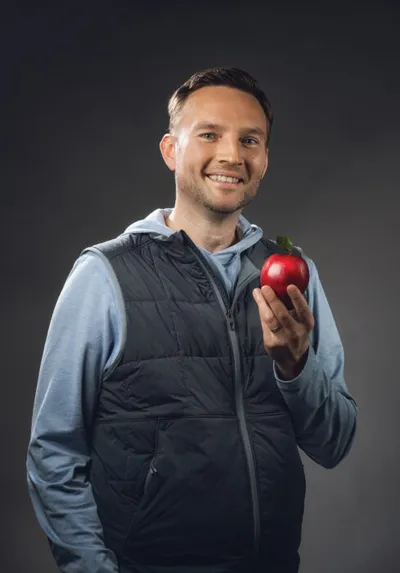
Fargo Public Schools Teacher of the Year Jim Urlacher i s All About Curiosity, Culture, and Second Chances On any given morning at Discovery Middle School, Jim Urlacher stands at the front of a classroom filled with seventh and eighth graders—students who are equal parts confident and uncertain, bold and unsure, trying on identities the


Fargo Public Schools Teacher of the Year Jim Urlacher i s All About Curiosity, Culture, and Second Chances
On any given morning at Discovery Middle School, Jim Urlacher stands at the front of a classroom filled with seventh and eighth graders—students who are equal parts confident and uncertain, bold and unsure, trying on identities the way other people try on jackets.
He wouldn’t have it any other way
“People say, ‘Oh, you’re a middle school teacher—bless you,’” Urlacher said. “And I always say, ‘Well, what do you teach?’ If they say elementary or high school, I bless them right back.”
He means it.
For 21 years, Urlacher has built his career in that in-between space—where kids aren’t little anymore but aren’t quite adults either. It’s messy. It’s emotional. It’s unpredictable. It’s also, in his words, one of the most important seasons of a person’s life.
And this year, Fargo Public Schools named him Teacher of the Year.
He was surprised. Emotional. Grateful.
From A Farm Near New England North Dakota To The World
Urlacher didn’t grow up imagining he’d one day be leading students through Spanish verb conjugations or hiking the Inca Trail with fellow teachers.
He grew up on a farm 20 miles outside New England, ND. His graduating high school class had 26 students.
Travel wasn’t something he thought about..
“It just wasn’t an option,” he said. “Growing up where I did, you don’t necessarily think about seeing the world.”
But he did think about language.
In high school, he took Spanish levels one and two. By senior year, he asked his superintendent if they could offer level three. The answer was that offering another class meant paying another salary, and that wasn’t feasible.
So he stopped—temporarily.
At NDSU, he started as a political science major. But Spanish stayed with him.
“I thought, why would I stop learning something I enjoy?” he said.
He shifted to Spanish education with an English minor. Then came the turning point: a six-week study abroad program in Peru.
He lived with a host family. Studied intensively—two hours each morning with one teacher, two hours each afternoon with another. Immersed himself completely.
And something clicked.
Dr. Paul Homan, then chair of the department at NDSU, strongly encouraged study abroad. Urlacher was working full-time and couldn’t leave for a full semester, so he found a six-week option. Homan approved it.
That decision changed everything. His host sister was four years old at the time.
His host brother was nine. Today, they’re adults. His host sister now lives in Germany—and he visits her there. He’s returned to Peru six times. He’s taken groups of teachers to hike the Inca Trail to Machu Picchu—twice.
“Growing up on a farm, I never would’ve thought I’d one day be leading people to Peru,” he said. “But that one experience opened the world.”

Teaching Beyond The Textbook
Travel reshaped how Urlacher sees the world, and how he teaches.
“When you speak another language, you learn how to communicate—even when you don’t have the words,” he said. “It gives you confidence.”
That confidence extends beyond vocabulary. It’s cultural awareness. Respect. Humility.
He tells his students about the concept of the “Ugly American”—the loud tourist who assumes everyone should speak English.
“When you go somewhere, you’re entering their culture,” he said. “You adapt. Not the other way around.”
He encourages assimilation, respect, curiosity. Free walking tours led by locals. Learning basic phrases. Observing before speaking
Why Middle School Matters
Ask Urlacher what he loves most about teaching, and he’ll tell you.
“Every day is new,” he said. “And even if a student—or I—have a bad day, the next day is a clean slate.”
Middle schoolers, he explains, are trying to figure out where they fit. Sometimes they perform for peers. Sometimes they push boundaries. Sometimes they act nothing like the kid you meet one-on-one.
“I think when you sit down with a student individually, you often see a completely different person,” he said.
His job isn’t just to teach Spanish. It’s to help them discover themselves. He suggests clubs. Connects students with other teachers.
Listens more than he talks.
“Often, they just need someone to listen,” he said. “If they’re comfortable with you, they’ll share. Then you can advocate for them.”
He exposes them to options. Lets them experiment. Encourages exploration over perfection. If they continue in Spanish, great. If not, that’s okay too.
“What matters is, did I teach them how to be a better student? A better person? Did I help them take advantage of opportunities?”
The Work People Don’t Always See
Teacher of the Year awards are often framed around what happens in the classroom—lesson plans, relationships, the daily rhythm of teaching.
But Urlacher’s impact is also built in the spaces outside the bell schedule: committees, curriculum work, community nights, and the slowand-steady labor of trying to make a school system better than it was yesterday
When he found out he’d been named Fargo Public Schools Teacher of the Year, he said his first reaction wasn’t pride so much as disbelief.
“I was very surprised,” he said. “Very emotional.”
In his mind, the award reflects years of teamwork—people pulling together, trusting each other, building something that lasts.
He points first to Discovery Middle School, where he’s spent the bulk of his 21-year career.
“We all support one another,” he said. “A lot of us have worked there for the past 20 years. It’s become a family. You take care of each other.”
“It’s Easy To Complain Be Part Of The Be Part Solution.
Over the last decade-plus, Urlacher has served on the district negotiations team, helping negotiate the teachers’ contract. He’s worked with district leaders on Spanish and world language curriculum. He’s served on more committees than he can count— building level, district level—where the work is slow, collaborative, and sometimes invisible to anyone outside the room
His philosophy is to not just identify problems. Instead, bring something forward.
“My goal is to always approach a problem by coming up with a potential solution ahead of time,” he said. “It’s really easy in the world to complain about anything and everything. But if you’re not willing to be part of the solution, it’s difficult to give yourself air time.”.
And he’s the type, he admits, who tends to raise his hand early when something new is being piloted.
“If you bring me a new concept and you’re like, ‘Hey, we want to try this out,’ I’ll be one of the first people to want to try it,” he said. “If it’s eventually going to become something, I’d rather be in the know.”
Bringing The World Into The School
Urlacher’s classroom is rooted in language, culture, and curiosity, but he’s also tried to build school-wide experiences that invite families and the community into that same spirit.
Years ago, when Discovery’s principal was Mrs. Herrick, Urlacher helped start an International Arts Night— bringing community members into the school to perform, create art with students, and share food..
They also ran an international club, specifically to engage students who might not normally plug into school activities.
They’ve done family fun nights. He invites parent volunteers into the building for his end-of-year “Fiesta” around Cinco de Mayo.
The Teacher, The Traveler, The Human Being
If you want to understand Jim Urlacher fully, you have to step outside his classroom.
Because for him, teaching isn’t confined to four walls.
It shows up in a kitchen and on a mountain trail in Peru.
Urlacher lights up when he talks about food.
“Half of traveling for me is eating,” he said.
He studies restaurant menus the way some people study museum maps. He seeks out local spots. He pays attention to ingredients. Techniques. Flavor combinations.
Then he comes home and tries to recreate what he tasted..
In his Spanish classes, especially around Cinco de Mayo, he hosts a small end-of-year fiesta. Parents volunteer. Students see him in a different light.
“I’m not a FACS teacher,” he said, “but if I could teach something else, it might be the cooking part.”
What Travel Really Teaches
Urlacher has been to Peru six times. Spain multiple times. Italy. Switzerland. Liechtenstein. Luxembourg. Denmark. Austria. France. The Netherlands. England. Germany. Canada.
He’s hiked the Inca Trail twice. Visited Machu Picchu four times—twice by train, twice on foot.
He still calls Cusco magical
“The world is such a huge place— you’ll never see all of it,” he saif. “But even the small portion I’ve seen… people are so welcoming. You can learn so much from them.”
Sometimes he plans carefully. Other times, the best experiences come from wandering.
“Sometimes the best things are when you don’t plan something out,” he said. “You just stumble on something and think, ‘Oh my gosh, I never would have thought that.’”
The Moment Every Teacher Hopes For
Ask Urlacher about his favorite teaching moment, and he struggles— not because there aren’t any, but because there are too many.
But then he lands on something specific.
“The most satisfying thing,” he said, “is when a student who struggled in middle school—academically or socially—comes back and shares future successes.”
Sometimes they thank him.
Sometimes, they apologize for how they behaved..
Sometimes, they simply show up as proof that the messy middle-school years didn’t define them.
Three of his former seventh- and eighth-grade students are now teachers at Discovery.
“That made me feel old,” he said.
There’s a saying in education: It doesn’t matter what you teach; it matters how you make them feel.
The Teachers Who Built Him
Urlacher is quick to point out that no teacher stands alone.
He named them without hesitation.
Mrs. Schlenvogt—his high school Spanish teacher (now deceased)—who held high expectations and proved that something doesn’t have to be easy for you to love it.
Mrs. Judy Schwan—his seventh-grade English teacher—who he said taught him everything he needed to know about English.
At NDSU: Dr. Carol Hawley. Dr. Carol Pearson. Dr. Paul Homan—the department chair who pushed him toward study abroad and, ultimately, toward the wider world. .
Later, at Minnesota State University Moorhead, where he earned his master’s degree in Teaching English as a Second Language, more professors who validated why he chose this path.
Many of his college professors had been high school teachers before becoming university faculty.
“They brought a different perspective,” he said. “One that really applied to what they were doing.”
The Clean Slate
If there’s one thread running through Urlacher’s life, it’s this: Every day is a fresh start.
Middle schoolers will test boundaries. Adults will disagree.
Systems will change. Travel plans will fall through. Students will struggle.
But tomorrow, you get another shot.
Published March 26, 2026
