MSUM President Tim Downs Isn’t Waiting For “Someday”
Tim Downs doesn’t talk like someone who’s just trying to keep the lights on. He talks like someone trying to build something. “There’s a theoretical premise for strategic planning,” Downs said. “It’s called strategic doing.” Some days are long—he’ll start at 8 a.m. and get home close to 10 p.m. But the schedule itself isn’t


Tim Downs doesn’t talk like someone who’s just trying to keep the lights on.
He talks like someone trying to build something.
“There’s a theoretical premise for strategic planning,” Downs said. “It’s called strategic doing.”
Some days are long—he’ll start at 8 a.m. and get home close to 10 p.m. But the schedule itself isn’t the point. The point is the constant processing.
“What are we doing?” he said. “And is it enough? Or should we be doing that?”
Some things, Downs said, look like perfect solutions until you try them. Then you learn. You adjust. You stop doing what doesn’t work and move on quickly, without ego.
That’s the mindset behind what Minnesota State Moorhead is building right now through a set of interconnected priorities aimed at keeping the university academically relevant, regionally engaged, and positioned for what comes next—especially in a world being reshaped by technology, workforce needs, and a growing skepticism toward higher education.
The Institute Of Applied AI
One of the most ambitious moves at MSUM right now is its Institute of Applied Artificial Intelligence (AI).
“We’re not going to come up with the next algorithm for AI,” he said. “That’s not who we are. That’s the California Institute of Technology. That’s MIT.”
MSUM’s lane is application. They are teaching people how to use the tools ethically, responsibly, and effectively—in the classroom, in careers, and in the real world.
That starts with faculty. Downs said the university has a group of “faculty fellows” who’ve become deeply knowledgeable about AI as a learning tool, then taken those insights into their own classrooms, and now help other faculty figure out how to adapt. Because whether educators like it or not, students are already using AI.
“It’s not going away,” Downs said. “Students are already using it whether they tell you or not. Let’s help them use it appropriately.”
In our conversation, he compared AI to the early days of the internet that included panic, predictions of job loss, and the assumption that everything would be automated. In reality, it became a tool—powerful, imperfect, and dependent on the person using it.
You still need your brain..
“You look at it and go, ‘No, that’s not it,’” Downs said. “And you have to reframe the question.
Maybe you didn’t give it enough of a framework, enough variables. You didn’t supply the context.”
Downs wants the university to serve as a regional resource—helping area businesses learn how to implement AI in ways that increase efficiency and strengthen operations.
He described speaking with a CEO at a local economic summit and asking them, “Do you use AI?”
The CEO said yes—barely—and mentioned one engineer trying to become the internal “expert.” Downs did what he naturally does, he connected people. He introduced the CEO to MSUM’s executive director of the Institute of Applied AI and pushed the relationship forward.
“He can help you, and then we can learn from you,” Downs told them. “And then we could use what you’re doing… in teaching our students how to run a business.”
This is an example of the two-way bridge the university is implementing where they’re supporting industry, and where industry shapes the university’s understanding of what graduates actually need.
Minnesota State Moorhead’s goal, Downs said, is not to be a distant institution tucked away behind closed doors. It’s to be a public asset— accessible, collaborative, and visible.
Opening The Doors
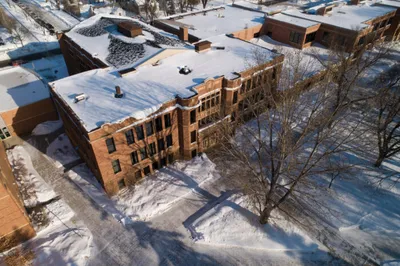
If you’ve driven past MSUM lately, you’ve seen the construction. Weld Hall, the university’s oldest building, is undergoing a $23 million renovation. When it reopens, it won’t just be updated. It will be reimagined.
A 400-seat auditorium. Space for lectures. Performances. Recitals. Public conversations. Thought exchange.
And Downs wants the community inside.
“If it’s a senior recital and your favorite instrument is piano or oboe, just come,” he said. “The door will be open.”
Downs sees universities as places of ideas. Not partisan spaces. Not ideological echo chambers. But venues where people can gather, listen, debate, explore, and learn.
“We stay apolitical,” he said. “But we can host people who have an idea.”
He wants Minnesota State Moorhead to be a magnet. A catalyst. A place where businesses come for workshops, teachers come for professional development, and residents come for events simply because they want to be part of something happening.
And that regional engagement isn’t just rhetorical.
This fall, MSUM faculty will help Moorhead school district teachers learn how to use AI tools in their classrooms— free of charge.
“They’re not paying us anything,” Downs said. “We’re doing it to help our public education partners.”
But even that generosity is strategic. MSUM will learn from those teachers, too—especially about what high school students are thinking and using.
The Question Everyone Is Asking
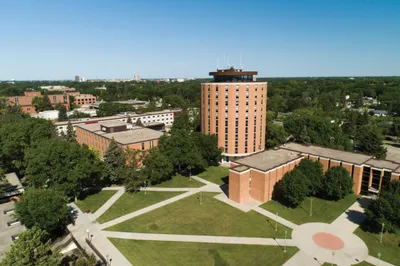
Of course, there’s a larger tension looming over all of this: the national debate about higher education itself.
Is college worth it?
“There’s a big debate out there right now,” he said. “Should you even go to college? I don’t have a one-size-fits-all answer.”
Instead, he frames it differently.
Every person is an “N-of-1” A case of one. A unique trajectory.
He talks about failing first grade because he couldn’t read— dyslexic, cross-eyed, and in what schools then called the “turtle group.” Three surgeries later, he could read. He regrouped. He moved forward. That early struggle shaped how he sees students now.
“There’s no linear model,” he said. “There’s no cookie-cutter path.”
Some students aren’t ready for college at 18. Some go into the military. Some work. For some, a gap year turns into a gap decade.
Others go to college immediately and treat it like a four-year party, accumulating debt without direction.
The real issue, Downs argued, isn’t whether college is universally necessary. It’s whether education is aligned with a person’s purpose and responsibility
“We need welders. We need electricians. We need PhDs,” he said. “We need all of it.”

What he pushes back against is the growing sentiment that no one should go to college.
“That’s wrong,” he said.
In his view, education—whether trade, technical, undergraduate, or doctoral—is fundamentally about human development. Critical thinking. Self-sufficiency. The ability to ask, “Wait a minute. Can we talk about that before we move forward?”
Keeping Talent Here
If education is about development, it’s also about geography
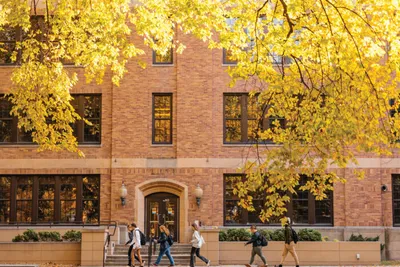
Downs is acutely aware of what happens when talented students leave the region.
“When you go away, you usually stay away,” he said.
That insight is driving one of MSUM’s most significant initiatives, the Moorhead Scholars program.
Previously, about 40 to 45 students per year from Moorhead High School enrolled at MSUM. This year? 141.
The program operates on a “last-dollar” model. Students apply their financial aid. Whatever remains on the table, Minnesota State Moorhead covers.
The goal isn’t simply access. It’s retention.
“These are talented students,” Downs said. “3.5, 3.7 GPAs. And they were leaving.”
To the Twin Cities. To Denver. Elsewhere.
If you want to build an economy, Downs argued, you need an intelligent, motivated workforce. And if you don’t make intentional investments, that workforce will build someone else’s region.
So MSUM invested.
Building The Thinkers
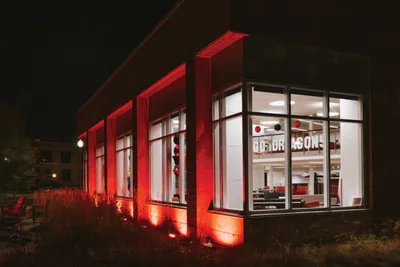
If the Moorhead Scholars program is about access and retention, MSUM’s new Honors College is about igniting a fire.
This fall, the university will formally launch its Honors College—expanding what had been a roughly 50-student honors program into a more robust, intentional cohort of around 100 students per year.
But this isn’t just about higher GPAs.
It’s about intellectual energy.
“These are the students who raise their hand,” Downs said. “The ones who’ve read the material and are ready to talk.”
The Honors College will be housed in Weld Hall after renovation, with dedicated seminar rooms and collaborative space, as well as an Honors Housing Community. Downs envisions it as something close to a think tank—a place where highly motivated students from different disciplines collide.
He tells the story of a prospective student who wants to be an ornithologist.
“She said, ‘I love birds,’” Downs recalled. “So I told her, we have a regional science center with acres of natural habitat. You could catalog every bird species out there. Study behavior. Publish research. Present at conferences.”
Her eyes widened.
“She’s already thinking about graduate school,” he said.
That’s the point.
Not to prescribe a path—but to build guardrails that help students pursue the path they already feel drawn to.
Put that aspiring ornithologist in a room with someone studying applied AI. Put them next to a student focused on entrepreneurship. Ideas start cross-pollinating.
“That’s how innovation happens,” Downs said.
The Larger Bet
At its core, Downs’ vision for Minnesota State Moorhead is neither flashy nor reactionary.
It’s steady. Strategic. Rooted in the belief that education—when done right—is a regional asset.
“We’re in the human development business,” he said. “And all humans are different.”
In a cultural moment where higher education is questioned, politicized, and sometimes dismissed outright, Downs’ defense is not defensive. It’s practical.
We need people who can think.
We need people who can weld.
We need people who can build businesses.
We need people who can analyze AI output and say, “That’s not it. Let’s reframe the question.”
And we need places that help them do it
MSUM, in Downs’ mind, is a connector, a catalyst, and a regional partner.
And the university is not waiting for “someday.”
It’s doing the work now.

mnstate.edu
Facebook | /msumoorhead
Instagram | @msumoorhead
Linkedin | /minnesota-state-university-moorhead
Published March 26, 2026
